Sources checked 30 October 2026 · Check your date with the provider
Some links are affiliate links. We may earn a commission on qualifying bookings at no extra cost to you. This does not determine your price or guarantee availability.
Use seasons as context, not a promise
PAGASA describes the Philippines broadly as tropical and maritime, with a rainy June–November period and a dry December–May period. It also explains that rainfall varies by region because of winds and topography. Those national labels are a starting point for travel planning, not a monthly operating calendar for Pagsanjan.
Do not read “dry season” as “no rain,” or “rainy season” as “all trips cancelled.” A travel date still needs current information. For a trip centred on the gorge, flexible bookings and more than one possible day can be more useful than an article claiming a single guaranteed best month.
Ask about three different operating decisions
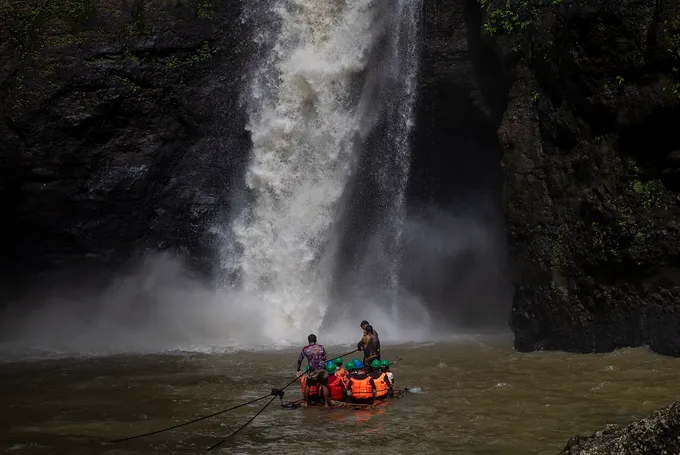
The canoe route, the bamboo-raft element near the falls and the separate Cavinti land approach are different activities. Ask which parts of your selected product are expected to run and who will inform you if that changes. A tour remaining for sale is not a live confirmation of every route element.
If the provider offers an alternative, establish its actual route, physical demands and financial terms. A land descent is not simply a dry version of the canoe, and another waterfall may involve a different trail. The route comparison explains why these options should be evaluated separately.
Where to look for current weather information
Use PAGASA’s current forecasts and time-stamped notices. Its Greater Metro Manila regional monitoring includes Laguna, so the regional rainfall and thunderstorm page is relevant to this trip. Read the issue time and affected places rather than only a weather symbol in a hotel app.
When a tropical cyclone is relevant, also check the official cyclone bulletin. PAGASA identifies July–October as the peak cyclone season, but that does not mean other months are free of storms. None of these pages is a Pagsanjan boat-operation feed; use them to ask better questions of the operator, not to declare the gorge open yourself.
A practical sequence for checking
Before booking, understand cancellation and rescheduling terms, including what happens if the canoe runs but another included element does not. In the days before the trip, look at the current official forecast and ask the operator when it will make or communicate the final decision.
Check again before leaving your hotel. If you are travelling independently, confirm the road transfer and the river booking together so you do not make a long journey based on an old message. Save the operator’s contact and booking details offline. A screenshot is useful evidence of a message, but its time stamp matters.
| When | What to establish |
|---|---|
| Before payment | Closure, partial-closure, cancellation and rescheduling terms |
| Before the travel day | Current official forecast and the provider’s update process |
| Before hotel departure | Whether the actual booked activity is expected to run |
| At check-in | The route and instructions applying to that session |
What a sunny morning does not tell you
The weather at a Manila hotel does not establish conditions along the gorge. Likewise, a photograph of dramatic water flow does not prove that a river activity is operating. This website does not estimate a safe water level or publish an unverified green-light indicator.
Ask your provider about the specific date and route, and follow instructions at the departure point. Do not persuade boatmen to continue because you have already paid or travelled far. Your practical choices are governed by the operator’s decision and the booking conditions, not the effort invested in getting there.
Plan for comfort without treating kit as protection from conditions
Bring a dry change of clothes, a towel and a way to protect the small number of items you take on the river. Ask what footwear and equipment the operator requires. A rain cover can keep luggage drier during a road transfer; it does not make a suspended activity appropriate to attempt.
The packing and photography guide separates items to keep with you from those better left in agreed storage. If you are sensitive to heat or humidity, discuss the day’s pace and waiting arrangements. Do not replace a provider’s suitability assessment with an optimistic interpretation of a forecast.
Make the backup genuinely flexible
An extra night can create another possible time slot, provided the hotel and tour permit changes and the activity can operate. Choose a fallback that matches actual conditions and your interests: a town meal, a heritage visit or simply keeping the day free. Check the suitability of the road journey as well.
For a short holiday, our editorial preference is to avoid putting the falls on the same day as a fixed flight. The day-trip guide and overnight plan show ways to separate the river from onward transport. A flexible plan is useful precisely because it does not pretend to control the weather.
Questions before you go
What is the best month for Pagsanjan Falls?
There is no month that guarantees suitable river conditions. Use broad seasonal information to choose dates, then check current official weather notices and your operator’s actual route decision.
Does rain automatically cancel every tour?
Not something this guide can determine. Operation depends on the activity and current local assessment. Ask the booked provider rather than interpreting rain alone as an open-or-closed signal.
Can the canoe run while the raft is unavailable?
Treat them as separate confirmation questions. Ask what your provider will do if only part of the booked experience can be offered, and check the written terms.
Does the planner show live river levels?
No. It helps organise your decisions and links official information. It does not assess water levels, forecast route access or replace the operator and local authorities.
Sources & editorial notes
We use official tourism and heritage records, operator information and accommodation listings. The notes below list each publisher once; the full bibliography retains individual sources. A source check is not a live operating-status check.
View the source bibliography →